
Access control supporting hospital operations
Oulu University Hospital is undergoing a complete transformation that will continue until 2030. The major redevelopment is being carried out in phases. New buildings are replacing the old hospital facilities built between 1968 and 1974. Throughout the project, the hospital remains fully operational. Most of the new facilities are already in use, while construction will continue until 2030.
In a large hospital complex, access control is about much more than opening doors. It plays a role in everything from managing isolation areas and visitor access to urgent patient transport and medicine storage. Access control helps keep the hospital safe, manage how different areas are used and make everyday work run smoothly. This is why access management was considered from the very beginning, based on the hospital’s security needs and everyday workflows. The technology was designed around the hospital’s needs, not the other way around.
Oulu University Hospital selected Securitas Technology Oy’s Unison access control system together with card readers from Idesco Oy. Several thousand Idesco readers have already been installed across the new facilities.
Balancing open access and restricted areas
Hospitals are demanding environments for access control, with people coming and going around the clock. And many of them are not hospital staff. Alongside employees, the facilities are used by patients, visitors, students and external service providers.
Access to areas such as treatment and procedure rooms needs to be restricted to maintain security, protect patient privacy and hygiene, and allow staff to work without unnecessary interruptions. Staff, visitors and service providers can access only the areas relevant to them. Access rights can be assigned based on factors such as job role, user group or time of day.
Managing access and security
In the new hospital, access control was extended to more doors and access routes to provide a higher level of security. While this means staff need to authenticate themselves more often, their daily routines have also become easier: instead of carrying several keys and credentials, they can use a single credential for different purposes. The change has also improved security and patient privacy.
“Although authentication is now required more often, staff felt it was a good thing that patient privacy and a peaceful working environment are protected and that people cannot simply walk into a ward directly from the street,” says Miika Suomela, Service Manager responsible for property information systems at the Wellbeing Services County of North Ostrobothia.
The new system has also made it easier to adapt access control as the hospital’s needs change. Departments and functions may move within the building, meaning that an area originally intended for staff may later be used by patients. Changes and new integrations can be configured directly in the system without having to redesign the access control arrangement.
“So far, we haven’t encountered a problem that we haven’t been able to solve with the system,” says Juha Haapakoski, Project Manager at Securitas Technology Oy.
Practical solutions to support operation
Isolation areas can be set up quickly
When a patient needs to be isolated, access to and from the area must be carefully controlled, while ensuring that the staff caring for the patient can enter. At OYS, certain areas can be quickly adapted for isolation use when needed. The normal route into the room is closed and access is redirected through an entrance area, where the doors operate in a controlled sequence to meet hygiene and security requirements.
Colour-coded readers
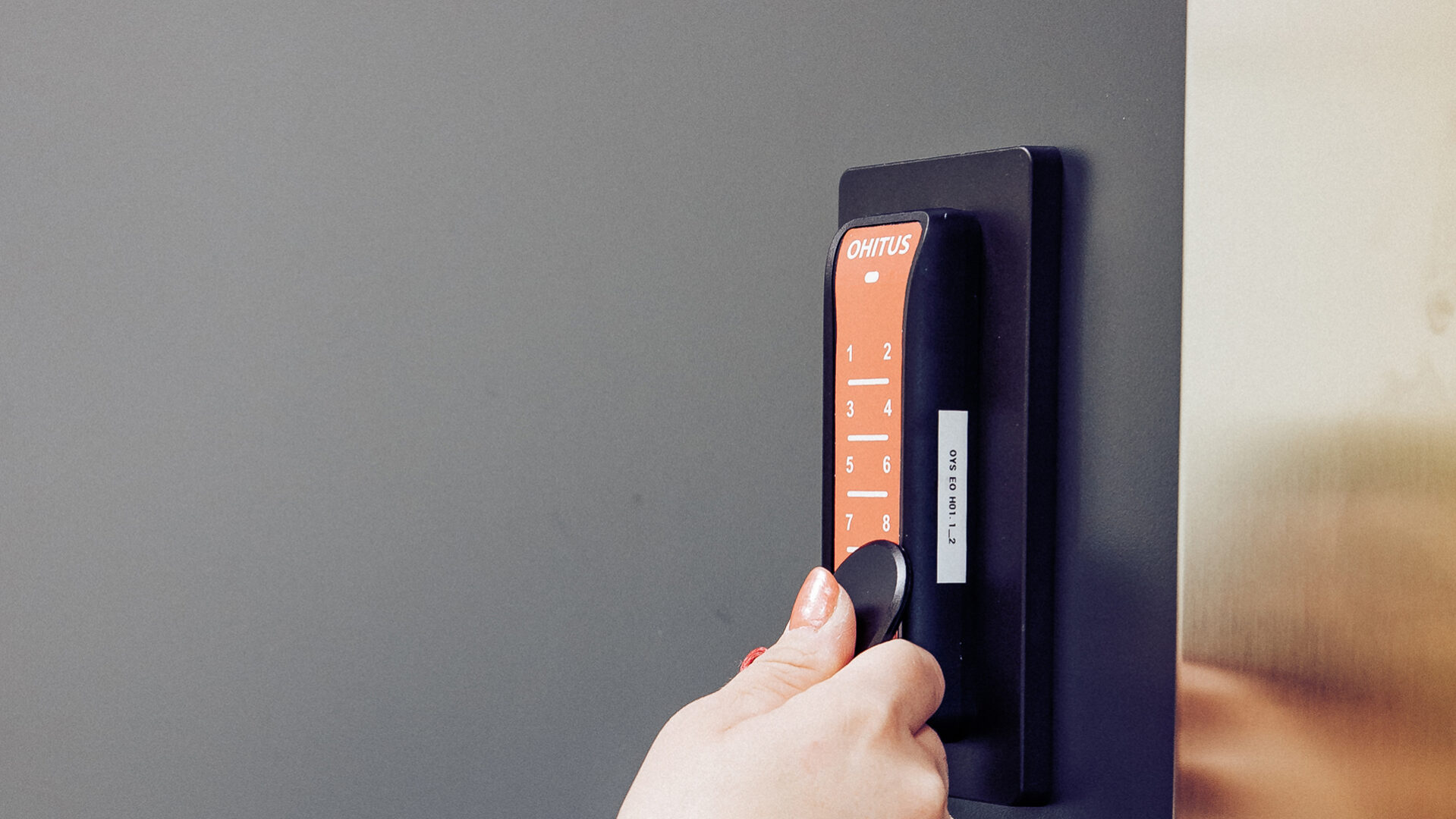
At OYS, readers for different functions are identified by colour. One reader may open a standard door, another both door leaves to allow a patient bed to pass through, while a third can be used to call a lift for staff only. Clear colour coding makes it easier for staff to choose the right function quickly in a busy hospital environment.
Priority lifts
In a hospital, every minute can matter. Service Manager Miika Suomela explains that when a patient needs to be transferred from the emergency department to intensive care, the staff transporting the patient call the lift using a red reader. This priority call overrides the lift’s normal operation. The lift drops off other passengers at the nearest floor before switching to the urgent call. This helps patients reach critical care without unnecessary delays.
Visitor credentials save time
Nurses can give family members, such as parents visiting a baby in intensive care, a credential that works only along a defined route from the entrance to the relevant area on the ward. Visitors can reach the right place independently, while remaining within the areas they are authorised to access. Staff no longer need to open doors or escort them through the hospital.
Temporary access with pin codes
At OYS, people who need temporary access can be given time-limited pin codes. The code works only for the required period and in specified areas, helping to maintain security. It also allows temporary access without issuing a separate key or credential. The readers are already equipped to support pin codes, so the feature can be introduced easily when needed.
One credential for multiple purposes
In the new OYS hospital, staff use the same credential to move between different areas, access lockers and other locked furniture, and use various everyday services. Access to medicine storage is limited to authorised employees, while the system also records who has entered the storage area and when.
A single credential has also made access rights easier to manage. Because rights are managed centrally, changes can be applied across different applications without separate updates in each system. For staff, this means the same credential can be used to access treatment rooms, lockers and medicine storage, or to book meeting rooms.
“In the old hospital, staff had at least an electromechanical key and a credential. In the new hospital, some employees have an electromechanical key because of their job role, but most healthcare staff manage with just one credential,” says Miika Suomela. “Having fewer keys also saves work and costs in key management,” he continues.
Vendor independence
Future changes were considered from the very beginning when the access control solution was planned. A hospital never stands still: new facilities, functions and user groups will continue to be introduced over the years.
Ownership of security keys, vendor independence and open technologies were therefore important selection criteria. OYS wanted to make sure that its credential technology, readers and credential management would not depend on a single supplier. The hospital also wanted to be able to use the same technology across different systems and avoid a situation where a change of supplier or technology would mean rebuilding the entire solution. These requirements led to the selection of Securitas Technology’s Unison system and Idesco readers.
“Anything can happen to a supplier over time. They might, for example, discontinue product development or something else could change. In that case, we don’t have to rebuild the entire system. We have such a huge number of users and so many readers,” says Service Manager Miika Suomela.
Future-proofed system and devices
Securitas Technology’s Unison system covers access rights and access area management as well as intrusion alarms. It is integrated with the hospital’s HR systems, furniture locking systems, electromechanical locking and digital signage system.
Scalability was one of the key requirements for the project. The system already includes several thousand readers, more than 5,000 access control devices and connections, and a large number of integrations, with the overall solution continuing to grow. It was designed to support further development as the hospital’s needs evolve. Doors can already be opened by mobile phone in some areas, and other digital authentication methods can be introduced in the future.
Idesco readers have also proved reliable in outdoor installations. “We can’t choose a device here that only works at minus ten or twenty degrees Celsius. It has to work in all conditions,” says Juha Paananen, Key Account Manager at Securitas Technology.
MIFARE DESFire is one of the most secure technologies available for access control, while also allowing the same credential to be used across different systems. OSDPv2 simplified cabling across the large hospital complex and enables encrypted communication all the way from the credential to the system controller.
Summary
At the new OYS hospital, access control makes daily work easier while helping to protect staff and patients as well as their privacy. Unauthorised people cannot enter areas where patients are treated or where valuable equipment and supplies are kept. Flexible, centrally managed access control also allows the hospital to respond quickly as its needs change, whether this means setting up isolation areas, managing urgent patient transport or adapting to new facilities and user groups.
Key benefits of modern access control solutions in hospital:
- Access rights can be changed quickly as needs change.
- Spaces can be reassigned to different uses without complicated access control changes.
- Visitors and transport service providers can reach the right areas securely.
- One credential can be used for multiple purposes.
- Staff do not need to carry several keys and credentials.
- Mobile phones can easily be introduced as credentials.
- Open technologies make it easier to develop the system in the future.
- The hospital owns its security keys and remains in control of how the system develops.